Understand the fitting families
Choose the family, then specify the actual components
1. Friction and butterfly-style backs
With friction earring backs, a compatible back grips a post without being screwed along a thread. Butterfly-style backs are a familiar form within this category. Use the family name to begin the brief, then identify the actual post and back proposed for the product. Their appearance alone is not a complete matching specification. Ask for the components to be reviewed together and record the agreed references with the finished earring.
2. Threaded posts and screw backs
For screw back earrings, the back engages a threaded post. The parts need a matching thread specification, including pitch; a similar-looking opening does not establish compatibility. In a development request, name the desired arrangement and ask for the proposed component details. Keep the approval record specific to that combination rather than treating every threaded back as interchangeable with every threaded post.
3. Integrated hoop closures
With hinged hoop closures, the opening is part of the earring body. The drawing and sample need to show how the moving section, upper pin, and receiving area relate. Other hoop constructions can use different arrangements, so identify the proposed mechanism rather than relying on the word "hoop." Request both open and closed views when the movement is important to the product decision.
4. Leverbacks, hooks, and other fittings
Leverback earring findings and open hooks belong to different construction families and should be named separately in a brief. Leverbacks include a hinged closing element, while an open hook has a different wearing and removal arrangement. Proprietary locking backs also require their specified matching components. Compare the actual fitting proposed for the design, and ask how it connects to the decorative body, rather than assuming a category label settles every detail.
Start a stud specification with the post and back
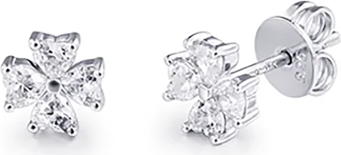
On the sideways earring, a straight post runs from the flower setting into a butterfly-style back with curled loops. The photograph shows the assembled parts, not removal or retention performance.
The flower stud reference shows a straight post entering a butterfly-style back on the sideways earring. This is useful for identifying visible parts, but earring post and back compatibility needs a documented specification beyond the photograph. Ask for the proposed post diameter, usable length, back reference, and any relevant locating details to be identified on the drawing or component record. Keep the front of the earring in the same review so the placement of the post can be assessed in context.
For stud earring post position, mark the attachment location on the reverse and relate it to the decorative outline. A centered geometric face and an elongated motif may raise different questions about orientation when worn. Ask the development team to show the proposed position rather than prescribing it from the front photograph alone. If the design changes, revisit the relationship between the face, setting depth, post, and back as one assembled product.
When comparing replacement earring backs, use the approved component specification or an actual matched sample as the starting point. Record what is being replaced and why, then ask for compatibility to be checked before adopting the new part. Color, apparent size, or a familiar shape should not be the only matching criteria. The final record should identify the replacement as a reviewed combination with the post, particularly when several stud designs share similar-looking components.
Read the hoop as a complete mechanism
The polished hoop reference has visible upper joins and a seam near the lower inner edge. A still image does not reveal how those parts move. For hoop earring closure identification, request an open view, a closed view, and a short operation demonstration for the actual sample. Ask the supplier to identify the mechanism and the relevant parts. This avoids turning a visible seam into an unsupported assumption about a hinge, latch, or locking action.
A hoop earring measurement brief should separate the internal opening from the outer outline and name the section measurements near the front, lower body, and upper connection where relevant. If the design is intended to sit close to the ear, describe the target proportions without treating "huggie" as a precise dimension. Record the measurement points on the drawing so changes to body width or curvature can be reviewed consistently across the proposed size range.
For hoop closure alignment, define the views and observations needed at sample review. The closed join, the relationship of the upper pin to the receiving area, and the movement of the opening section should be visible to the reviewers. If a stone or decorative surface is moved near the join, ask whether the surrounding construction needs revision. Record the agreed sample review method and acceptance criteria for the actual design instead of borrowing a performance promise from another closure type.
Connect the fitting to the decorative drop
01. Attachment
For drop earring findings, the upper fitting and the lower decorative element should be drawn together. Identify the point where they connect, the direction of the loop, and whether movement is intended. A clear front image may still leave the attachment ambiguous, especially when the connector sits behind a stone or under a small upper element. Ask for an enlarged connection view if the drawing does not make the assembly understandable.
02. Fitting & silhouette
With leverback earring connections, describe the decorative element that will attach to the fitting and the direction it should face. An open hook request needs the same care with the attachment point and lower element, even though its closure arrangement differs. Keep the fitting name separate from the product style: a long drop, a compact pearl element, and a geometric pendant-like shape can raise different questions about proportion and movement when connected to an upper part.
03. The complete pair
For left and right drop earrings, record whether the pair is identical or mirrored and show both pieces in their intended facing direction. If movement is part of the design, request a demonstration that includes the complete pair rather than an isolated fitting. List the relationships the review should assess, such as clearance between neighboring elements and the resting orientation of the motif. These notes turn "matching pair" into a visible, reviewable product requirement.
Specify materials for each component
Component identity
An earring findings material specification should identify the post, back, body, and any separate connection parts relevant to the design. Do not assume that a material description for the decorative front automatically describes every fitting. Request the intended component information as part of the project record and list any documentation requirements. If an alternative part is proposed during development, record its identity and ask for the effect on the assembled product to be reviewed.
Finish requirements
For earring finish matching, include front, reverse, and fitting views when comparing the intended appearance. A small back or pin may be visually secondary, but the brief should still describe its finish requirements. Name the material and coating request separately, and ask how the chosen specification applies to each component. Where a finish is changed, review the complete sample and the relevant documentation instead of assuming the alteration affects only color.
Substitution records
Use a jewelry component substitution record when a proposed post, back, hook, or closure differs from the approved reference. State the reason for the change, the part it replaces, and the review needed before acceptance. A matching commercial description is useful for communication, but the approved product definition should remain tied to the actual combination. This is especially helpful when the same collection contains several sizes or decorative fronts using related fittings.
Build a closure specification that can be checked
Identification and measurements
Begin the earring closure checklist with the product reference, revision, fitting family, and the proposed component identifiers. Add the dimensions that the design team considers relevant, with units and measurement locations. For a post-and-back arrangement, ask for the matching information to be recorded together. For an integrated closure, include the drawing views that explain the closed shape and opening relationship. Unknown fields can remain open questions until the correct information is available.
Visual and operation references
An earring closure sample review should have a clear purpose. Specify which front, profile, reverse, open, and closed views are required for the design, then add an operation demonstration where relevant. The photographs on this page are appearance references and cannot replace that demonstration. Keep observations separate from acceptance decisions: a reviewer may describe what is visible while still requesting additional information before approving the construction.
Approval and traceability
Maintain a matched earring component record linking the drawing, material information, sample reference, and approved revision. If there are several sizes or finishes, state which combinations have been reviewed and which remain proposed. Store the final comments with the product file rather than only in a message thread. A later replacement or reorder can then be compared against a specific reference instead of a generic fitting name.
Frequently Asked Questions
Common questions from designers, brands and buyers
specifying earring backs,
fittings and closures for custom manufacturing.
Treat earring back compatibility as a product-specific question. Identify the post and the proposed back, then review the required matching details or a physical matched sample. Similar appearance is not enough to confirm a replacement. Keep the approved pairing in the product record and revisit it when either component changes, particularly if several designs use parts that are difficult to distinguish visually.
Use an earring closure comparison that starts with the complete design and the requirements of your brand. Product format, dimensions, appearance, intended handling, and documentation needs all belong in the discussion. There is no single recommendation on this page for every earring or wearer. Ask for suitable proposed arrangements and review the actual sample against agreed criteria before deciding which belongs in the product specification.
Submit an earring back change request identifying the current arrangement, desired alternative, and the reason for the change. The post and its connection to the front should be included in the review. A new back may require a different matched arrangement rather than a direct substitution. Ask the project team to confirm the proposed scope and sample requirements for that particular design.
Use the replacement earring finding specification from the approved product record, including component identity, relevant dimensions, material and finish requirements, and the product revision. Add a clear photograph or matched physical sample when available. If the original specification is incomplete, ask for the arrangement to be reviewed before ordering. The replacement discussion should end with an identified compatible combination and an updated record for future reference.
Butterfly earring backs slide onto a compatible post and hold through friction. Traditional screw back earrings use a threaded post and a matching back that turns into position. When discussing your collection, tell us whether easy handling, the appearance of the back, or a particular fastening method is your priority. We can review the proposed arrangement with you and identify the details to confirm on a physical sample.
A wider support pad may help support a larger stud, but the complete earring still needs to be reviewed. When considering supportive earring backs, share the front dimensions, approximate weight, post position, and photographs showing the tilt. We can discuss a suitable support arrangement and the sample checks needed. Review how the complete pair sits when worn before approving the design for your collection.
For hinged hoop earrings, check that the hinge moves smoothly, the post aligns with its receiving point, and the closure engages consistently on both earrings. Inspect contact surfaces for rough edges and compare the opening and closing feel across the pair. Tell us about sticking, excessive looseness, or difficulty fastening. Agree on any repeated-operation checks and acceptance criteria before production, and retain the approved pair as the reference.